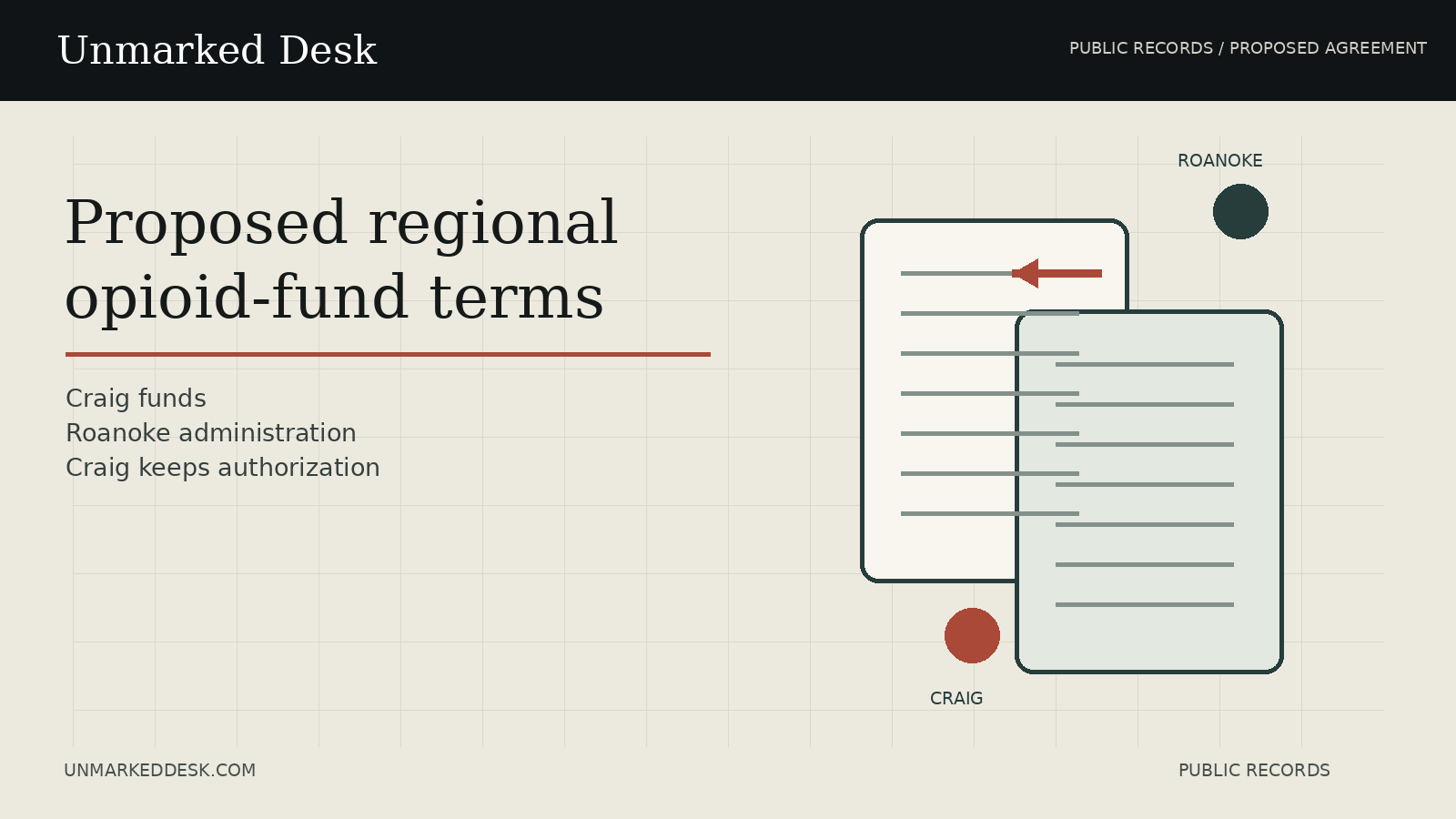
Roanoke County’s October 13 agenda materials describe a proposed agreement under which Craig County would transfer its direct-distribution opioid-settlement funds to Roanoke County each year for regional opioid-abatement work. The arrangement would not give Roanoke unilateral authority over Craig’s money: the draft says Craig would remain responsible for its authorizations, certifications and local commitments. The packet establishes proposed terms. It does not establish an adopted ordinance, signed agreement or completed transfer.
What was before the board
The Board of Supervisors agenda listed an ordinance authorizing a memorandum of understanding between Roanoke County and Craig County for regional opioid abatement, plus acceptance and appropriation of Craig County funds. It was labeled “First Reading and Request for Second Reading.” The agenda is public here.
The accompanying staff report and draft materials, on pages 66 through 74 of the agenda-with-reports packet, say Roanoke would act as Craig’s delegate for applications, required reporting and selection of projects benefiting Craig residents. Craig would transfer all of its direct-distribution settlement funds annually. The materials do not state the first transfer amount or an annual dollar figure. Read the official packet.
What Craig would keep
The proposed division of labor is narrower than a simple handoff. Craig would retain responsibility for signing and authorizing documents, certifications and local commitments concerning its funds. It would participate in cooperative grant applications, while Roanoke’s individual, non-cooperative applications would remain Roanoke’s own.
The staff report says Craig has no organization providing these services within the locality and that residents frequently travel to the Roanoke Valley. That is the county staff’s stated rationale for the proposal; it is not an independently verified inventory of every provider or a measure of how many residents would receive services.
Dates and exit terms in the draft
The proposed agreement would begin January 1, 2027 and run through June 30, 2039. Either county could terminate for any reason with at least seven days’ written notice, according to the draft. It also calls for periodic expenditure accounting and required non-confidential reporting. Unspent money would be handled under Opioid Abatement Authority rules.
The staff report recommends a second reading on October 27, and the attached proposed ordinance carries that date. Those are procedural materials, not proof that the board took the first-reading action or that a later reading will occur as described. Roanoke County directs readers to its agendas, archived records and meeting-minutes access; a final vote record and executed agreement were not verified for this report.
What to watch next
The useful public checkpoints are straightforward: the final motion and vote in each county, a signed agreement, the amount Craig actually transfers, project budgets, expenditure reports and evidence of services used by Craig residents. None of those should be assumed from a proposed agreement alone.
Source note: Based on Roanoke County’s October 13, 2026 agenda and agenda-with-reports packet, especially pages 66–74, checked October 14, 2026. The article distinguishes the proposal from outcomes that were not verified. Graphic: original Unmarked Desk editorial illustration.